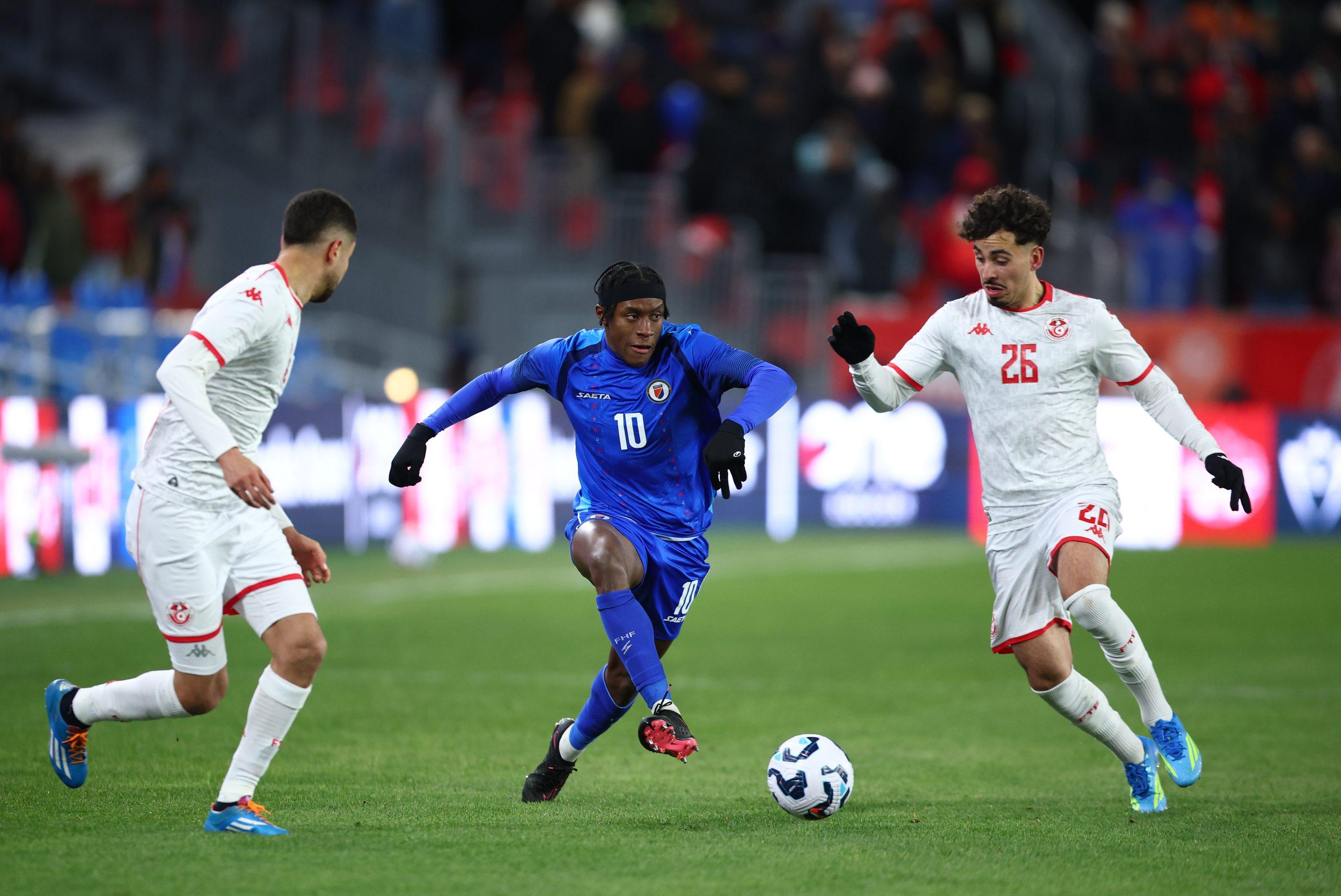
There is a particular silence that follows a goal scored too early. Not the silence of defeat, but of recalibration — the crowd inhaling, the players rearranging the architecture of their ambitions. Haiti fell 0-1 to Tunisia at BMO Field in Toronto on March 28, 2026, in a World Cup 2026 friendly that will linger longer than the scoreline suggests. Seven minutes in, Sebastian Tounekti received the ball from Ismaël Gharbi, and with the quiet efficiency of a sentence that needs no revision, struck it home. The evening had barely begun, and already it demanded a different kind of courage.
Toronto in late March still carries winter in its breath. The diaspora watched from the stands, from living rooms in Flatbush and Montréal-Nord, from phone screens held in the palms of hands that also hold two passports, two allegiances, two ways of saying home. For Haiti, this was not simply a friendly. There are no friendlies when your nation is preparing for its first World Cup in a lifetime. Every match is a rehearsal for belonging on the stage the world has long told you that you do not deserve.
Tunisia understood this. They arrived in their 4-3-3 with the controlled discipline of a nation that has been to six World Cups, that carries the memory of 1978 and 2022 in its footballing blood, that knows what it means to represent an entire continent’s pride. Their midfield moved like conversation — quick exchanges, pauses that held meaning, sudden accelerations that left Haiti’s double pivot searching for answers in space that had already closed.
And yet Haiti did not collapse. The nation’s colors — blue and red, born from a revolution that rewrote the possibilities of freedom — held their shape. At halftime, the coaching staff made a declaration: three attacking substitutions. Nazon, Isidor, Expérience. The names alone read like a statement of intent. We have come here to be seen. The 4-2-3-1 stretched forward, the midfield grew bolder, and the second half became a different match entirely — Haiti pressing, probing, refusing the narrative of Sebastian Tounekti’s early goal.
Tunisia’s defense, organized and unyielding, absorbed wave after wave. There is an art to defending a one-goal lead, a patience that mirrors the patience of nations that have learned to endure. But Haiti, too, knows endurance. Haiti invented endurance.
Danley Jean Jacques had already been cautioned in the 58th minute — the kind of yellow card born from the frustration of chasing a game that refuses to turn. Then, in the third minute of stoppage time, a foul. The referee reached for his pocket again. A second yellow. Red. Jean Jacques walked off the pitch carrying the particular loneliness of a man whose evening ended not with a goal but with an early exit, while his teammates fought the final minutes without him.
Enjoying this story?
Get match recaps and heritage stories delivered to your inbox after every match day.
This is what football does to nations that carry their history close to the skin. It does not merely disappoint. It offers, then retracts. It teaches you that the rehearsal is as sacred as the performance.
Haiti chose Tunisia deliberately as part of their World Cup 2026 preparation — Tunisia’s style a mirror of Morocco, who awaits in the group stage. To study Tunisia’s defensive composure, their transitional sharpness, their North African fluency with the ball, is to begin reading the chapter that Morocco will write this summer. And Haiti, now, has read the first pages.
There is a friendly against Iceland still to come. More rehearsals. More cold stadiums in borrowed cities. More chances to refine the machinery of a dream that began not in a boardroom but in the red soil of a Caribbean nation that, two hundred and twenty-two years ago, told the world what was possible.
The score will say 0-1. But the score has never been the whole story.
Never miss a moment.
Subscribe to Roots & Moments. Cultural match recaps hit your inbox after every World Cup match day.
Explore the heritage stories behind every World Cup nation on the Roots of Glory app.