
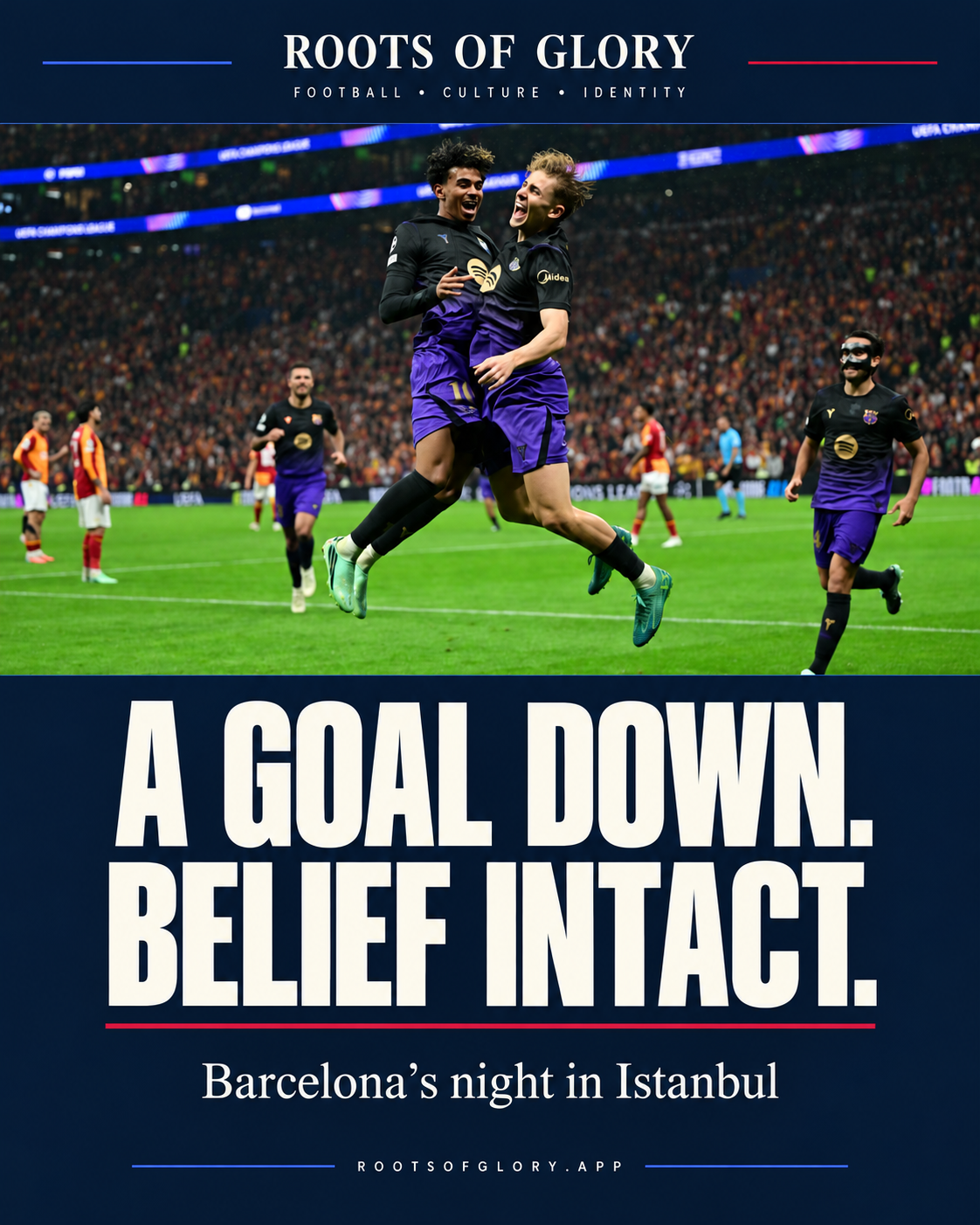
A final score can hide the uncertainty that came before it.
Barcelona’s 4–1 victory over Galatasaray in Istanbul on October 13 looks commanding on paper. But Barça had to come from behind, reach halftime level and then take control after the interval. The result delivered a second consecutive Champions League victory.
For a supporter, those are different experiences inside the same match: watching a team fall behind, waiting for an answer, then seeing possibility become something more substantial.
That distance between uncertainty and relief is part of football’s hold on people. We remember the result, but we often carry the turning point longer.
Before the match, Hansi Flick had spoken with respect about the atmosphere awaiting his team, describing the noise inside Galatasaray’s stadium as incredible. His assessment acknowledged something the scoreboard cannot measure: an away team must contend with the emotional force of a place as well as the players in front of it.
That matters to the story of this victory. Galatasaray’s supporters belong in its telling. Their presence gave the occasion its intensity; Barcelona’s response gave the visitors their result.
For Barça followers beyond Catalonia, matches like this can also become shared reference points. A club supported across borders offers people a common language: a goal, a nervous interval, a message sent when the match turns. You do not need to occupy the same stand to understand why someone else is celebrating.
One comeback does not guarantee a trophy. It does not settle every question about a team or predict how it will respond to the next difficult evening.
But it gives supporters another reason to stay with the match when the opening chapters are uncomfortable.
In Istanbul, Barcelona had to find an answer. The lasting appeal of the evening lies in that response: the score changed, and with it, the feeling of what was possible.
Sources & further reading
- FC Barcelona: Galatasaray 1–4 FC Barcelona, October 13, 2026 Source checked
- FC Barcelona: Hansi Flick on the atmosphere, October 12, 2026 Source checked