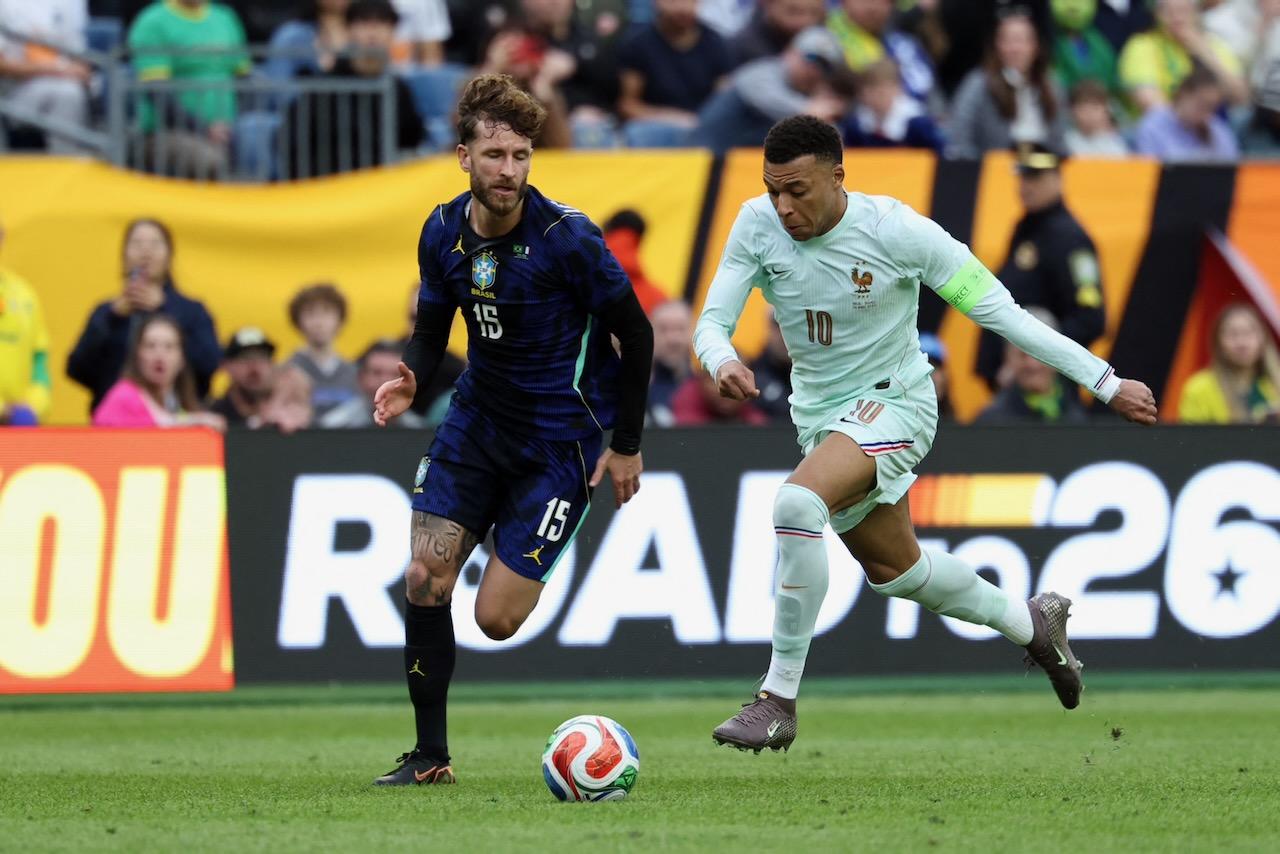
The grass was new. Laid down to replace the artificial turf, mandated by FIFA for a tournament still months away, it smelled like a thing just beginning. Gillette Stadium in Foxborough, Massachusetts, that concrete cathedral off Route 1, had been dressed for a different kind of congregation. France defeated Brazil 2-1 on March 26, 2026, in a World Cup 2026 friendly before an attendance of 66,215 — most of them draped in canarío yellow, the color of a country that has not lifted the trophy since Ronaldo’s redemption in Yokohama twenty-four years ago. They came from Brockton, from Newark, from Framingham and Fall River — the Brazilian communities that have quietly reshaped New England for decades. Their drums made the March air warm.
But this is the thing about diaspora: it moves in every direction.
Kylian Mbappé’s mother is of Algerian descent. His father is Cameroonian. Ousmane Dembélé carries Mali, Mauritania, and Senegal in his bloodline. When France lines up, it fields a squad whose roots reach into Kinshasa and Guadeloupe, into the Sahel and the banlieues of Paris where boys play on concrete until someone notices their feet. This is not incidental to French football. It is the whole architecture. The nation’s colors — bleu, blanc, rouge — contain more geographies than the flag admits.
Thirty-two minutes in, Dembélé threaded a pass with the calm of someone posting a letter. Kylian Mbappé collected it, looked up, and chipped the ball over Ederson with the soft precision of a man placing a book back on a high shelf. Kylian Mbappé’s goal — his 56th for France — moved him within one of Olivier Giroud’s all-time France international scoring record of 57. The Brazilian crowd went quiet the way an ocean goes quiet between waves — not silent, but holding its breath.
Then the match turned strange. Raphaël Upamecano, already cautioned, fouled again. The referee consulted the screen. Upamecano was shown a red card — yellow upgraded on VAR review for denying a clear goal-scoring opportunity. Fifty-fifth minute, and France were reduced to ten men. The yellow-clad majority roared. Surely now. Surely the mathematics of bodies on grass would assert themselves.
It did not happen that way.
At the sixty-fifth minute, Michael Olise — born in London, raised between England and France, of Nigerian and French-Algerian heritage — slid a pass to Hugo Ekitéké. The Liverpool forward, twenty-three years old, Cameroonian roots woven into his French upbringing, dinked the ball past the keeper with the lightness of someone skipping a stone across water. Hugo Ekitéké’s goal made it 2-0. Ten men. The stadium fell into the particular silence of disbelief, which is different from disappointment.
Mbappé walked off the pitch moments later, substituted, his night’s work complete.
Enjoying this story?
Get match recaps and heritage stories delivered to your inbox after every match day.
Brazil pulled one back through Bremer in the seventy-eighth minute — Bremer’s goal a deflected cross turned in after Casemiro kept it alive in the box. The crowd remembered itself. The drums returned. In added time, Vinícius Jr., brilliant and maddening in equal measure, found himself alone with the goal and chose the wrong foot. The ball sailed wide. He stood there a moment, hands on hips, staring at the grass as though it owed him something.
It did not.
Before kickoff, Jayson Tatum had walked out for the coin toss alongside Massachusetts Governor Maura Healey — a basketball star blessing a football pitch, which felt appropriately American. Gillette Stadium will host France again during the World Cup 2026 group stage, their final match against Norway. The new grass will be older then, broken in, bearing the memory of every boot that tested it.
France left Foxborough with their eighth game unbeaten, their seventh win. Brazil left with three defeats in their last six, carrying the weight of a nation that remembers 2002 the way one remembers a dream — vividly, but with the growing suspicion that it belonged to someone else.
In the parking lot afterward, a woman in a yellow jersey folded her flag carefully, tucking it under her arm. Near her, a man in blue was on the phone, speaking rapid French, laughing. Two diasporas, side by side in Massachusetts, walking to their cars under the same cold sky.
The grass was new. Everything else was ancient.
Never miss a moment.
Subscribe to Roots & Moments. Cultural match recaps hit your inbox after every World Cup match day.
Explore the heritage stories behind every World Cup nation on the Roots of Glory app.