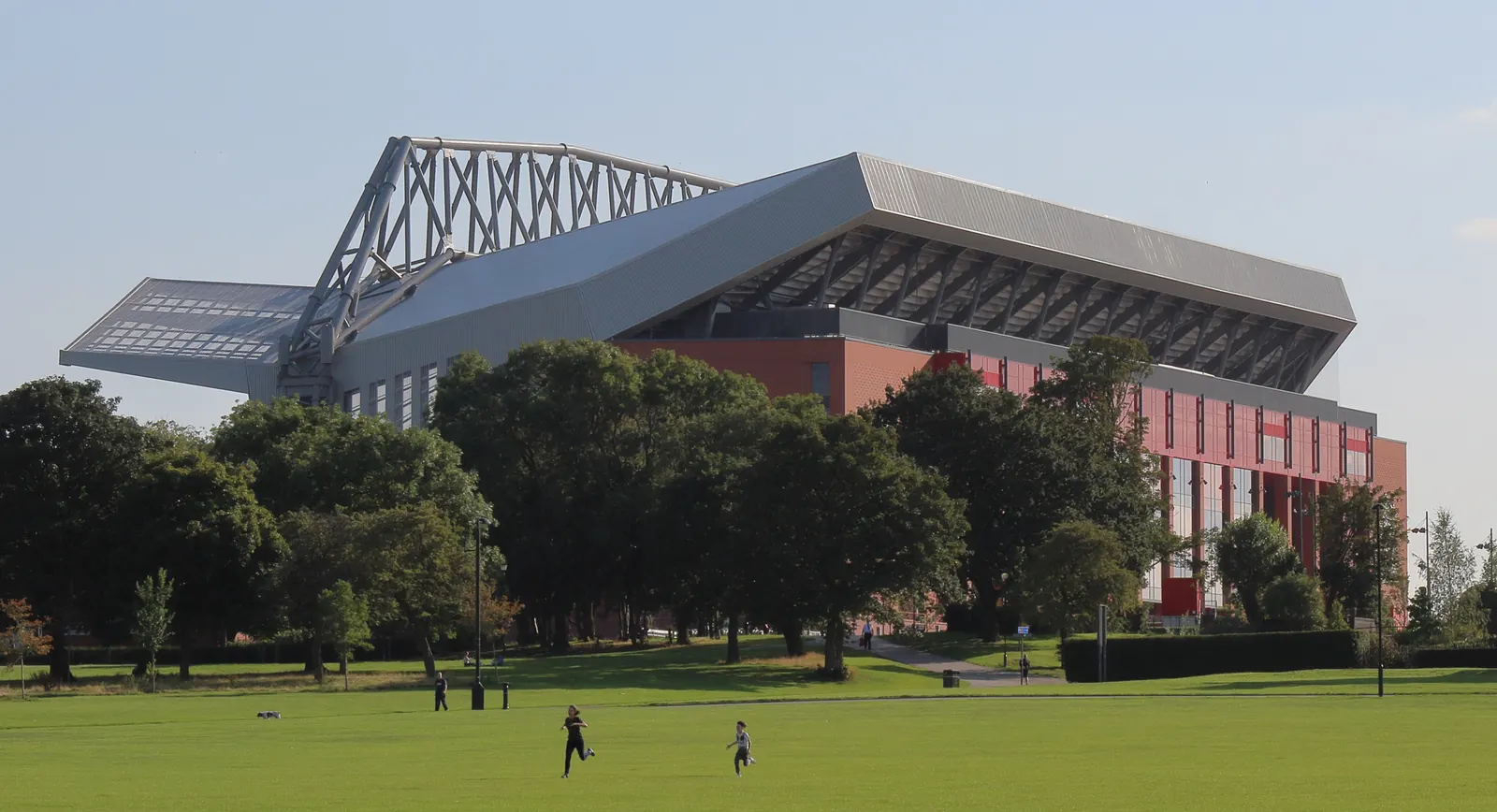

A stadium's public calendar is usually organized around fixtures. The record of Liverpool's Red Neighbours programme shows another calendar running beside it: school holidays, regular gatherings and practical activity in community spaces.
The Foundation's programme description identifies work around Anfield, Kirkby and Melwood. It groups that work around food and education, social isolation, physical activity and opportunities for young people. These are different needs from the ones a match ticket is designed to meet. Foundation programme description
A June 12, 2026 activity report gives that framework a more concrete shape. It describes food-hamper deliveries during the May school break, a cookery session at Anfield involving the Adult Health programme and Kirkby Community Centre, and regular Tai Chi in Bootle. It also describes Monday Club as a gathering built around social activity. These are the Foundation's reported activities, rather than independently measured outcomes. June activity report
The variety is part of the point. Food support answers an immediate material need. A cooking session has a different purpose from a food delivery. A recurring group offers a reason to return. Putting them under a club-associated programme does not make them interchangeable; it creates several routes through which the institution may be encountered outside a game.
For someone who knows Liverpool primarily through football coverage, that changes the scale of the club story. The relevant unit is no longer only the crowd assembled for a match. It can be a local group, a school connection or a room used on an ordinary weekday.
There is also a difference between reach and relationship. A one-off event can bring many people together. A recurring session can create continuity. Neither format is automatically better, because each addresses a different purpose. The useful question is whether the activity fits the need it is intended to serve.
The Foundation's account makes that question possible by naming specific forms of work. It does not, by itself, establish how consistently every need is met. A list of sessions should not be read as a complete evaluation of access, quality or lasting effect. The programme can be described precisely without converting its stated ambitions into a verdict on the whole neighborhood.
That distinction preserves the value of the activity record. There is no need to claim that a cooking class transforms a city in order to recognize that a stadium can be used for something other than matchday hospitality. There is no need to make every participant a lifelong supporter for a club-associated gathering to have a purpose.
The broader idea is simple: a club occupies time in a place as well as space. Its neighbors live through the weeks between fixtures. A community programme that works on those weeks gives a reader another way to understand what local presence can mean.
Anfield's match calendar remains one part of that presence. The other calendar is written in regular activity, not final scores.
Sources & further reading
- Liverpool Foundation: Community engagement Source checked
- Red Neighbours activity round-up, June 12, 2026 Source checked